
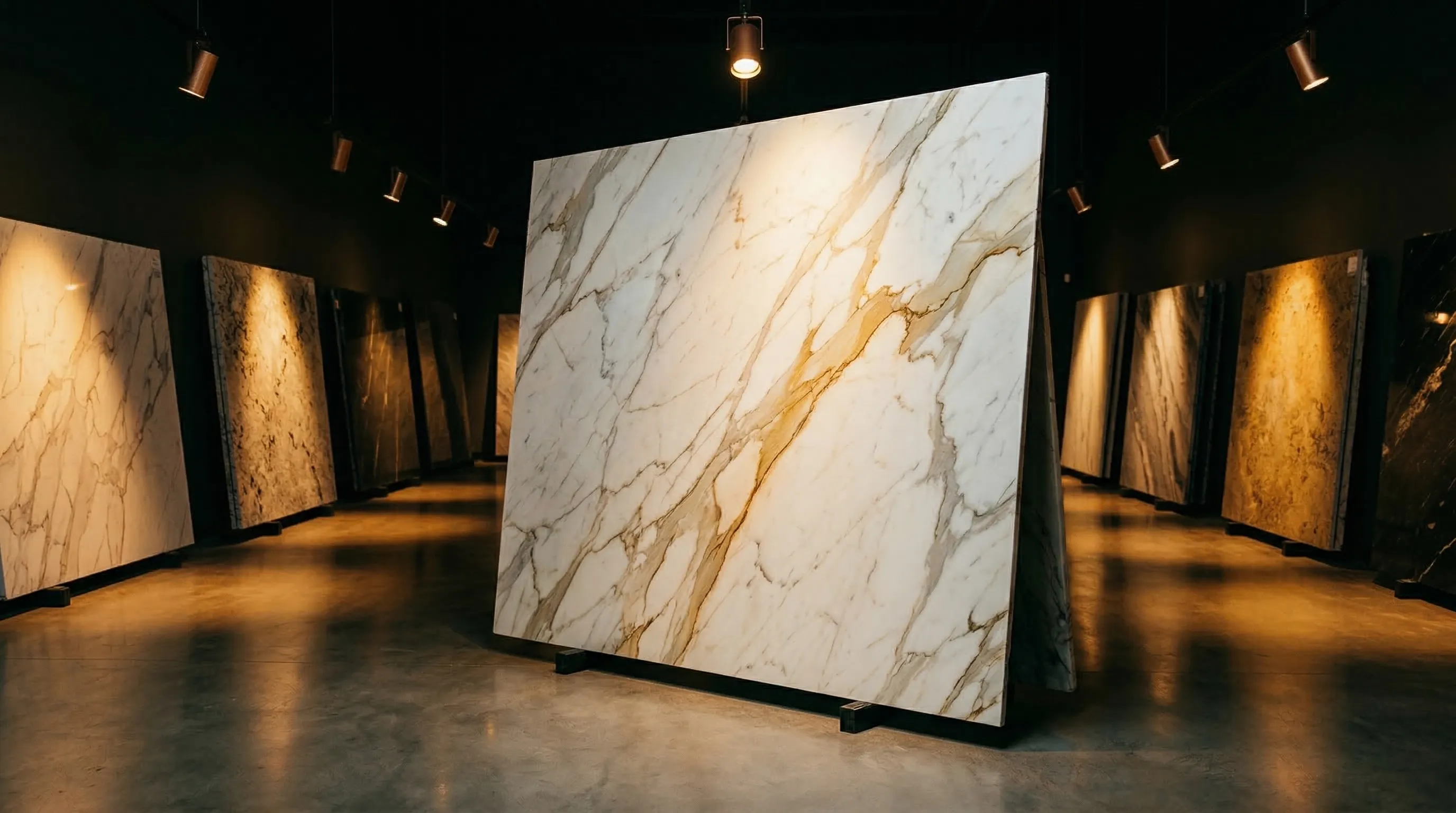
Stone & Tile Glossary
A comprehensive glossary of natural stone, tile, and fabrication terminology. Learn the language of stone from the experts at Baystone.
Antique Finish
A surface treatment that gives stone an aged, weathered appearance through brushing, tumbling, or chemical processes. Popular for rustic and Mediterranean designs.
Backsplash
The vertical surface between a countertop and upper cabinets, typically 4 to 18 inches tall, designed to protect the wall from splashes while adding visual interest.
Bookmatching
A technique where two consecutive slabs are opened like the pages of a book and placed side by side, creating a mirror-image pattern. Highly prized for feature walls, shower surrounds, and kitchen islands.
Bullnose
A rounded edge profile applied to countertops or tile edges, available in full bullnose (completely rounded) or half bullnose (rounded on top only). One of the most popular edge treatments.
Bush-Hammered
A textured surface finish created by mechanically striking the stone with a bush hammer tool, producing a rough, cratered texture with excellent slip resistance. Commonly used for outdoor paving.
Calibrated
Stone or tile that has been ground to a uniform thickness, ensuring consistent installation across large areas. Essential for large-format tiles and seamless flooring.
Chamfer
A small angled cut along the edge of stone or tile, typically at 45 degrees, that softens the edge while maintaining a clean, geometric appearance.
Cleft
A natural, rough surface texture that results from splitting stone along its natural bedding planes. Common in slate and flagstone, providing a rustic, textured appearance.
Cross-Cut
A cutting method where stone is sliced perpendicular to the natural bedding plane, revealing a more mottled, cloudy pattern. Contrast with vein-cut, which follows the veining direction.
Dolomite
A calcium magnesium carbonate mineral that forms a natural stone harder than marble but softer than quartzite. Often confused with marble, dolomite offers better durability with similar aesthetics.
Dupont Edge
A countertop edge profile featuring a short, beveled top edge above a longer, curved lower edge. Creates a traditional, elegant look associated with luxury kitchens.
Efflorescence
A white, powdery deposit that appears on stone surfaces when water-soluble salts migrate to the surface and crystallize as moisture evaporates. Common in new installations and usually diminishes over time.
Epoxy Resin
A bonding material used to fill natural fissures, pits, and cracks in stone slabs during fabrication. Strengthens the stone and prevents debris from collecting in natural voids.
Fabrication
The process of cutting, shaping, polishing, and finishing raw stone slabs into custom countertops, vanities, and other surfaces. Includes templating, cutting, edge profiling, and cutout creation.
Fissure
A naturally occurring crack-like formation within stone that is part of its geological structure. Unlike a crack, a fissure does not compromise structural integrity and is a normal characteristic of natural stone.
Flamed
A surface finish produced by applying a high-temperature flame to the stone surface, causing the surface minerals to pop and creating a rough, non-slip texture. Commonly used for outdoor applications.
Fluting
Decorative parallel grooves carved into a stone surface, often used on columns, wall panels, and bathroom vanity fronts. Adds texture and visual interest to flat surfaces.
Gauged
Stone that has been machine-cut to a specific, uniform thickness. Gauged stone is easier to install than ungauged (natural cleft) material because it provides a flat, consistent surface.
Granite
An igneous rock composed mainly of quartz, feldspar, and mica, formed from slowly cooling magma. One of the hardest and most durable natural stones, rated 6-7 on the Mohs scale.
Grout
A cement-based or epoxy-based material used to fill the joints between tiles. Proper grout selection and maintenance are essential for the longevity and appearance of tile installations.
Honed
A smooth, matte surface finish that lacks the reflective quality of polished stone. Created by grinding the surface to a consistent smoothness without the final polishing step. Popular for contemporary designs.
Igneous Rock
Rock formed from the cooling and solidification of magma or lava. Granite is the most common igneous stone used in countertops, known for its extreme hardness and durability.
Kerf
The width of a cut made by a saw blade during stone fabrication. Understanding kerf width is important for precise measurements and minimizing material waste.
Large Format
Tiles or slabs that exceed standard dimensions, typically 24x24 inches or larger. Large-format installations create a seamless, modern appearance with fewer grout lines.
Leathered
A textured surface finish that provides a soft, undulating feel while maintaining a subtle sheen. Created by running diamond-tipped brushes over the surface. Hides fingerprints and adds tactile character.
Limestone
A sedimentary rock composed primarily of calcium carbonate. Softer than granite and marble, limestone offers warm, subtle coloring and is popular for floors, walls, and exterior applications.
Lippage
An uneven condition where adjacent tiles or stone pieces are not flush with each other, creating a lip or ridge at the joint. Minimizing lippage is critical for smooth, professional installations.
Marble
A metamorphic rock formed when limestone is subjected to heat and pressure. Prized for its luminous veining and soft, warm appearance. Rated 3-5 on the Mohs scale.
Metamorphic Rock
Rock that has been transformed from its original form by extreme heat and pressure within the earth. Marble (from limestone) and quartzite (from sandstone) are the most popular metamorphic stones.
Mitre (Miter)
A joint made by cutting two pieces of stone at complementary angles (typically 45 degrees) so they meet at a corner. Used for waterfall edges, thick edge profiles, and seamless corner joints.
Mohs Scale
A scale of mineral hardness from 1 (talc) to 10 (diamond) used to rate the scratch resistance of natural stone. Marble rates 3-5, granite 6-7, and quartzite 7-8.
Ogee
An elegant S-shaped countertop edge profile that combines a concave curve on top with a convex curve below. A classic, traditional choice for luxury kitchens and formal settings.
Onyx
A translucent, banded form of calcite (not to be confused with the mineral onyx). Dramatically beautiful and often backlit for decorative installations. Very soft and best used in low-traffic areas.
Patina
The natural change in appearance that occurs on stone surfaces over time through use and exposure. Many homeowners value the patina that develops on marble and limestone as it adds character and warmth.
Polished
The most common stone finish, achieved by progressively finer grinding and buffing to produce a mirror-like, reflective surface. Enhances color depth and veining but shows fingerprints and water spots more easily.
Porosity
The measure of void space within stone that determines how readily it absorbs liquids. Highly porous stones (limestone, travertine) require more frequent sealing than dense stones (granite, quartzite).
Poultice
A paste-like cleaning compound applied to stone surfaces to draw out deep stains. Typically made of an absorbent material (diatomaceous earth, baking soda) mixed with a chemical agent appropriate for the stain type.
Quarry
An open-pit excavation from which natural stone is extracted. Each quarry produces stone with distinctive characteristics — color, veining, and mineral composition vary by quarry location.
Quartzite
A metamorphic rock formed when sandstone is subjected to extreme heat and pressure. One of the hardest natural stones (Mohs 7-8), quartzite offers marble-like beauty with superior durability.
Resin-Filled
A process where natural pits, fissures, and voids in stone are filled with colored resin during processing. Common in travertine and some marbles. Strengthens the slab and creates a smoother surface.
Sealant (Sealer)
A protective treatment applied to natural stone surfaces to reduce porosity and prevent staining. Impregnating sealers penetrate below the surface; topical sealers form a surface coating.
Sedimentary Rock
Rock formed from the accumulation and compaction of sediment over millions of years. Limestone, travertine, and sandstone are sedimentary stones used in construction and design.
Semi-Precious Stone
Natural minerals and gemstones (agate, amethyst, tiger eye, labradorite) fabricated into slabs for luxury surfaces. Often translucent and used with backlighting for dramatic effect.
Soapstone
A soft, dense metamorphic rock composed primarily of talc. Naturally non-porous and resistant to stains and acids. Develops a rich, dark patina over time. Does not require sealing.
Template
A precise measurement of a countertop or surface area, typically made with digital laser equipment, used to guide the fabrication of stone to exact specifications.
Thermal Finish
See "Flamed." A finish created by applying intense heat to the stone surface, resulting in a rough, slip-resistant texture ideal for outdoor applications.
Travertine
A form of limestone deposited by mineral springs, characterized by natural holes and pitting. Available filled or unfilled, and in multiple finishes. Popular for flooring, walls, and pool decking.
Tumbled
A finish achieved by tumbling stone pieces in a drum with abrasive grit, producing soft, rounded edges and a weathered, antique appearance. Popular for backsplashes and rustic installations.
Vein-Cut
A cutting method where stone is sliced parallel to the natural bedding plane, revealing linear, flowing veining patterns. Produces the dramatic striped appearance seen in many marbles and travertines.
Waterfall Edge
A design technique where the countertop material continues vertically down the side of a cabinet or island, creating a seamless cascade effect. Requires precise mitre cuts and color matching.
Ready to Explore?
Now that you know the terminology, visit our showroom to see these materials, finishes, and edge profiles in person. Our stone specialists speak the language fluently and are ready to help.