

How Custom Stone Fabricators Hide Countertop Seams
Countertop seams are hidden or minimized through careful slab selection, precise fabrication, strategic seam placement, and professional installation. Skilled custom stone fabricators treat the seam as part of the countertop design rather than an afterthought.
A well-planned seam should blend naturally with the stone's color, pattern, and overall layout. This becomes especially important with natural materials, where veining and mineral patterns vary from slab to slab. Understanding the fabrication process can help homeowners, designers, and contractors make better decisions before fabrication begins.
Why Countertop Seams Matter
A countertop seam is the joint where two pieces of stone meet. Seams become necessary when a countertop is larger than an available slab, has a complex layout, or requires separate pieces around corners, sinks, or other features.
A seam cannot always be eliminated, but its visibility can often be reduced significantly. The goal of professional countertop fabrication is to make the joint look intentional and visually consistent with the surrounding surface.
Poorly planned stone countertop seams can become distracting for several reasons:
- The seam may be positioned in a highly visible area.
- Two slabs may have noticeably different colors or patterns.
- The joint may be wider or uneven.
- The edges may not align properly.
- The adhesive color may contrast with the stone.
- Natural veining may stop abruptly at the seam.
For this reason, countertop seam placement should be considered during the design and measurement stages, not after the stone has already been cut.
How Custom Stone Fabricators Hide Countertop Seams
Experienced custom stone fabricators use several techniques to reduce countertop seam visibility. These techniques begin before fabrication and continue through final installation.
Choosing and Matching Stone Slabs
Stone slab matching is one of the most important steps in creating seamless looking countertops. Natural stone contains unique variations in color, movement, veining, and mineral patterns.
Fabricators can examine multiple slabs and determine which pieces work best together. This is particularly important for heavily veined materials such as marble and quartzite.
When possible, fabricators plan cuts from compatible slabs so adjacent countertop pieces have similar tones and patterns. The goal is not to make natural stone look artificial, but to create a visually balanced transition.
For dramatic materials, slab layout can also determine how prominently a seam appears. Selecting slabs together before fabrication gives the project team more control over the final appearance.
Planning the Best Seam Location
Not every location is equally suitable for a countertop seam. Fabricators consider the countertop's dimensions, cabinet layout, sink position, corners, appliances, and stone characteristics.
A seam may be less noticeable when positioned where natural breaks already exist in the design. For example, a seam can sometimes be placed near a sink, cooktop, corner, or other feature instead of across a large uninterrupted surface.
However, the best location depends on the specific countertop. A professional fabricator should evaluate the entire layout rather than follow a fixed rule for every project.
Using Precise Cutting and Fabrication
Precision plays a major role in countertop seam visibility. The pieces need to be cut accurately so their edges meet properly during installation.
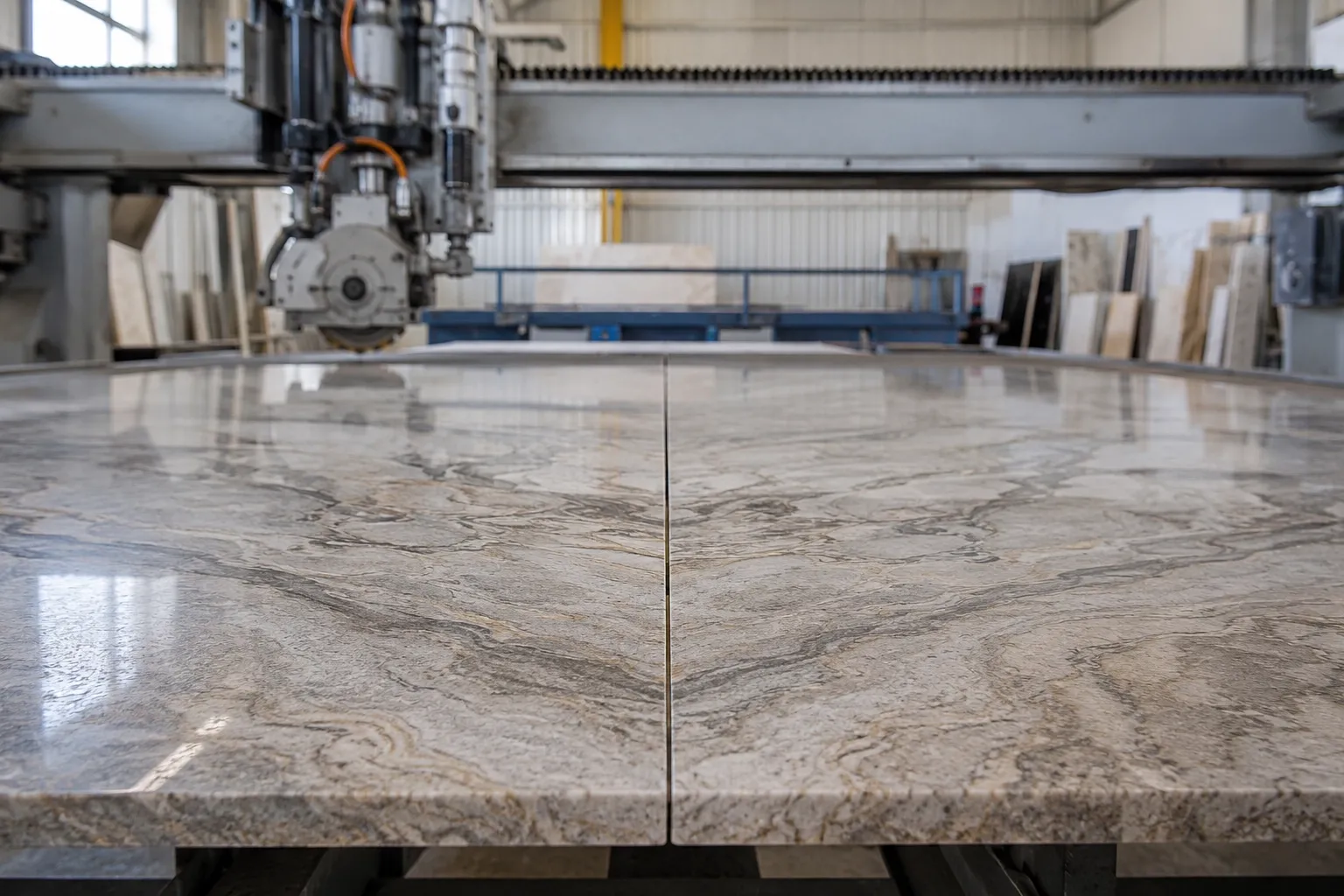
Modern custom stone fabrication can use advanced CNC equipment and waterjet technology to produce highly precise cuts for stone countertops. These techniques are particularly useful for projects with detailed shapes, openings, curves, or complex layouts.
Creating a Tight, Color-Matched Seam
Once the stone pieces are ready, the installer brings the edges together and uses an appropriate adhesive to join them.
Color matching matters because even a small contrast can draw attention to a seam. Fabricators can select an adhesive color that complements the surrounding stone, helping the joint blend into the surface.
The pieces also need to be properly aligned and supported. A tight, level joint creates a smoother transition than an uneven or poorly supported connection.
What Makes Countertop Seams More Noticeable
Several factors can increase countertop seam visibility. Some relate to the stone itself, while others result from fabrication or installation decisions.
Highly contrasting stone patterns can naturally make a seam easier to see. Dark materials may also make a contrasting adhesive more noticeable. Meanwhile, strongly directional veining can create an obvious visual interruption if the pattern does not align.
Seam placement also matters. A joint running through a large, open area may attract more attention than one positioned near an existing design feature.
Common factors that affect visibility include:
- Stone color and pattern
- Veining direction
- Slab consistency
- Seam location
- Cutting precision
- Adhesive color
- Installation quality
- Lighting conditions
This is why professional countertop fabrication involves more than simply cutting a slab to size. Each decision contributes to the appearance of the finished surface.
How Stone Type Affects Seam Visibility
Different natural stones respond differently to seam placement and matching. A consistent granite pattern may make a joint relatively easy to blend, while dramatic marble veining can require much more planning.
Marble often contains prominent veins that travel across the slab. If those veins do not align between pieces, the seam may become more obvious.
Quartzite can present similar challenges because some varieties contain bold movement and contrasting mineral patterns. Granite can range from relatively uniform patterns to highly dynamic designs, so the specific slab matters.
For heavily patterned materials, countertop veining matching becomes an important consideration. In some applications, fabricators may also plan slabs using a bookmatched layout, where two pieces create a mirrored visual relationship. This approach is especially useful when the stone's natural movement is intended to become a major design feature, as demonstrated in bookmatched stone installations.
Ultimately, there is no single stone that guarantees an invisible seam. The material, slab selection, design, and fabrication process all influence the result.

Choosing the Right Stone Fabricator
Choosing an experienced stone fabricator can have a major impact on the finished countertop. Look beyond the stone itself and evaluate how the fabricator handles measurement, slab selection, cutting, finishing, and installation.
A qualified fabricator should be able to explain where seams will be located and why those locations make sense for the design.
Fabrication and Cutting Capabilities
Ask what equipment the fabricator uses and whether fabrication is performed in-house. Advanced cutting equipment can provide greater control over complex countertop shapes and detailed layouts.
You should also ask how the company handles slab measurements, edge profiles, sink cutouts, corners, and unusual countertop configurations.
Experience With Natural Stone
Natural stone requires an understanding of its individual characteristics. Two slabs of the same material can have different veining, movement, color variation, and structural features.
An experienced stone fabricator knows how to evaluate these differences before cutting. That experience can help with slab positioning, pattern continuity, and practical seam placement.
Installation and Seam Finishing
Even accurately fabricated pieces can produce disappointing results if installation is poorly executed. The installer must align the pieces, create a suitable joint, apply the adhesive correctly, and ensure the finished surface is level.
Ask about the company's installation process and how it approaches color-matched countertop seams. A fabricator that handles both fabrication and installation can maintain better continuity throughout the project.
For project-specific questions, homeowners and professionals can contact Bay Stone Depot to discuss stone selection, fabrication, and countertop requirements.
Conclusion
Countertop seams are a normal part of many custom stone projects, but they do not have to dominate the finished design. The most effective approach combines careful slab selection, thoughtful countertop seam placement, precise cutting, and professional installation.
Custom stone fabricators can reduce seam visibility by treating the entire countertop as one coordinated design. Matching compatible slabs and considering natural veining before fabrication can make a significant difference.
The right fabricator will also explain where seams are needed and how they can be positioned to complement the countertop. With proper planning and craftsmanship, natural stone can deliver a refined surface where seams blend naturally into the overall design.